

No products in the cart.
Return To Shop
Return to previous page
Common PPE mistakes that every safety engineer must avoid.
 A safety engineer’s responsibility does not stop at simply providing Personal Protective Equipment (PPE) and mandating its use; it extends to ensuring its complete effectiveness and suitability. There are organizational and technical errors that some safety engineers make when managing and implementing PPE:
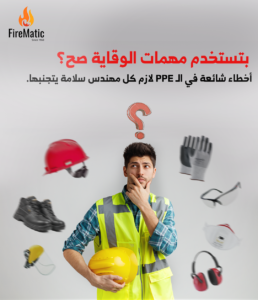 A safety engineer’s responsibility does not stop at simply providing Personal Protective Equipment (PPE) and mandating its use; it extends to ensuring its complete effectiveness and suitability. There are organizational and technical errors that some safety engineers make when managing and implementing PPE:
1. Relying on PPE as the First Line of Defense (Ignoring the Hierarchy of Controls)
Error: Jumping straight to solving the problem by distributing PPE without evaluating the possibility of eliminating the hazard, substituting it, or applying engineering controls.
Correction: PPE is the Last Line of Defense. The Hierarchy of Controls must always be applied first.
2. The “One-Size-Fits-All” Policy
Error: Purchasing protective equipment in uniform sizes or failing to account for individual differences among workers (such as special sizes or women-specific designs).
Correction: Incorrectly sized equipment does not provide the required protection (e.g., a loose mask leaking gases, or loose boots causing trips) and leads workers to remove it.
3. Ignoring Inter-Equipment Compatibility (PPE Compatibility)
Error: Requiring workers to wear multiple pieces of equipment simultaneously without verifying whether they can be combined effectively.
Example: Wearing a hard hat alongside ear defenders and safety glasses may exert excessive pressure on the worker’s head or prevent the glasses from sealing properly against the face.
Correction: Select integrated PPE or perform technical verifications to ensure equipment does not conflict when worn together.
4. Neglecting Technical Certifications and Standards
Error: Purchasing protective gear based on low price or visual appearance without verifying compliance with international standards.
Correction: Ensure recognized certification standards are present, such as ANSI (American) or EN (European), and verify the specific standard code for the hazard type (e.g., EN 388 for mechanical risk gloves).
5. Settling for Handover Without Training on Donning & Doffing
Error: Assuming the worker automatically knows how to use the equipment properly.
Correction: Conduct practical training and perform fit testing, particularly for respirators and safety harnesses, and train workers on safe removal techniques to avoid cross-contamination.
6. Neglecting Expiration Dates and Storage Conditions
Error: Using old hard hats or safety harnesses that appear intact externally, but whose plastic materials or fibers have degraded due to UV radiation or aging.
Correction: Establish a periodic inspection and decommissioning schedule, and provide a dry, dark storage environment away from heat and chemicals.