

No products in the cart.
Return To Shop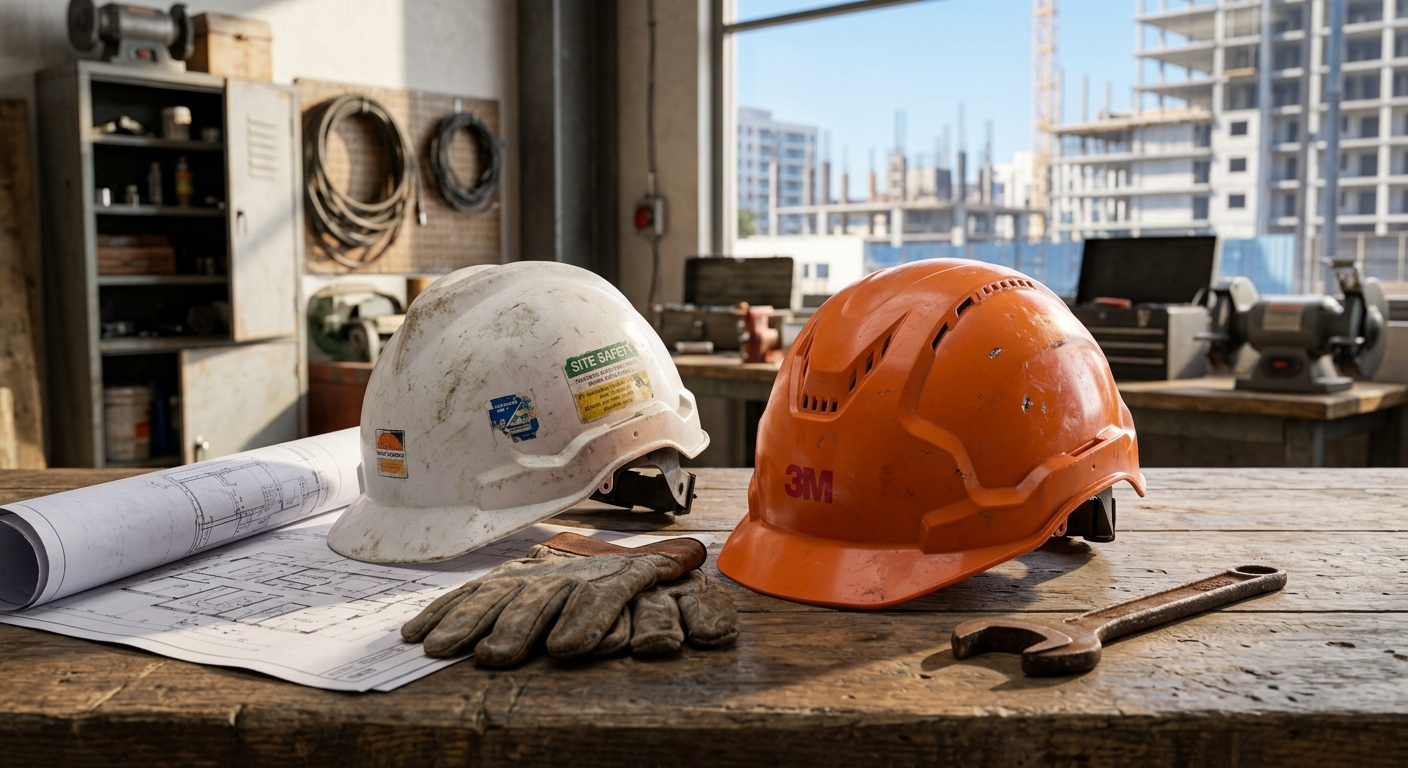
The Technician’s Ultimate Guide to Industrial Safety Helmet Types: Engineering Standards, Classifications, and Selection Criteria
Introduction: Your Head is Your Greatest Asset – Why All Helmets Are Not Created Equal and How to choose safety helmets ?
In technical, mechanical, and construction environments, your head is exposed to constant site hazards—ranging from falling tools and heavy building materials to low-hanging metal structures and live electrical conductors. An industrial safety helmet is far more than a basic plastic hat; it is a precision-engineered energy-dissipating system designed to reduce mechanical shock and protect the brain and skull from catastrophic trauma.
Selecting the wrong helmet for a specific job hazard provides a false sense of security. This technical guide delivers an in-depth breakdown of safety helmet types, international compliance standards, and selection metrics to help technicians choose the right head protection.
International Standards & Technical Classifications
Safety helmets undergo rigorous mechanical, thermal, and electrical laboratory testing. The two most recognized global benchmarks are the American ANSI/ISEA and European EN standards.
1. ANSI/ISEA Z89.1 (American National Standard for Industrial Head Protection)
This standard categorizes hard hats based on impact force direction and electrical insulation capacity:
By Impact Type:
Type I: Designed solely to absorb top-of-head impact forces resulting from objects dropping vertically from above.
Type II: Engineered to absorb both top and lateral (side, front, and rear) impacts, making them essential for technicians working around moving overhead hazards or at risk of falling sideways.
By Electrical Protection Class:
Class G (General): Tested to withstand up to 2,200 Volts. Ideal for general construction and technical trades.
Class E (Electrical): Tested to withstand up to 20,000 Volts. Specifically designed for high-voltage electricians, linemen, and utility technicians.
Class C (Conductive): Offers no electrical insulation. These helmets feature ventilation ports or metallic elements to maximize airflow in hot working environments where no electrical hazards exist.
2. EN 397 (European Standard for Industrial Safety Helmets)
Mandatory testing criteria under EN 397 include:
Shock Absorption: Limits the peak force transmitted to the head form to no more than 5 kN.
Penetration Resistance: Prevents sharp, heavy objects from puncturing the shell.
Flame Resistance: Ensures self-extinguishing properties upon brief exposure to direct flame.
Optional Advanced Certifications:
Low-voltage electrical insulation up to 440V AC.
Lateral Deformation (LD) resistance against side-crushing forces.
Protection against Molten Metal splash (MM).
Sub-zero temperature testing down to -20°C or -30°C.
3. EN 12492 (Helmets for Mountaineering and Working at Height)
Tailored for technicians working on scaffolding, towers, or rope access systems. It requires a high-strength chinstrap (retaining force > 500 N) to prevent the helmet from dislodging during a fall.
4. EN 812 (Industrial Bump Caps)
Intended for tight workspaces where technicians might bump their heads against fixed objects (e.g., machinery frames, undercarriages). Note: Bump caps do NOT protect against falling or swinging objects and are not substitutes for EN 397/ANSI hard hats.
Anatomical Components & Material Engineering
A professional industrial safety helmet functions through four critical components:
Outer Shell: Formed from high-performance polymers:
HDPE (High-Density Polyethylene): Lightweight with superior chemical resistance.
ABS (Acrylonitrile Butadiene Styrene): Exceptional rigidity and impact toughness.
Polycarbonate: Excellent heat resistance and high impact strength.
Suspension Harness System:
A 4-point or 6-point webbed harness maintains a critical clearance gap (25 mm to 30 mm) between the outer shell and the skull. This webbing absorbs and distributes impact energy before it reaches the wearer.
Adjustment Mechanism (Ratchet Suspension): A smooth rear-dial wheel ensuring a snug, precise fit for all head sizes without creating pressure points.
Sweatband: High-absorbency lining that manages sweat and enhances comfort during long shifts in hot climates.
Technical Spotlight: Tested & Reliable Helmets at Fire Matic
Analyzing the product line available at Fire Matic, the brand emphasizes internationally certified, field-tested PPE for industrial reliability:
1. MSA V-Gard® Safety Helmet
Global Industry Benchmark: Trusted worldwide across oil & gas, manufacturing, and heavy engineering sectors.
V-Shaped Structural Geometry: The iconic trademark V-design deflects overhead impact forces outward away from the crown of the head.
Harness System: Equipped with the Fas-Trac® III Ratchet Suspension for superior comfort, stability, and zero pressure points.
Certifications: Fully compliant with ANSI/ISEA Z89.1 (Class E) and EN 397.
2. 3M™ Peltor™ G3000 Safety Helmet
Advanced Ergonomics for Demanding Environments: Engineered for extreme durability with optimized ventilation slots to reduce heat buildup.
Exclusive UVicator™ Sensor: Features a smart patented disc that changes color as UV radiation degrades the shell material. This visually alerts the technician when the helmet has reached the end of its service life and requires replacement for guaranteed safety.
Personal protective equipment is your last line of defense against workplace hazards. Investing in tested, certified head protection is an essential step toward ensuring long-term safety and operational compliance.
At Fire Matic, we offer an extensive, field-tested selection of top-tier Safety Helmets (MSA, 3M) alongside a comprehensive range of Personal Protective Equipment (PPE), Fire Fighting Equipment, and Fire Alarm Systems. All our products are guaranteed, tested, and compliant with local and international standards.
👉 Prioritize your safety today! Click here to visit the Fire Matic Products Page and explore our complete catalog of certified PPE and safety solutions.


Related posts
The PPE Field Reality: Gear You Can Trust When It Matters Most As a technician, maintenance specialist, or HSE site engineer in Egypt, your... Continue reading

The PPE Myth: Why International Certification—Not Country of Origin—Is the True Benchmark of Industrial Safety & PPE Introduction: “Made in China or India” – Myth... Continue reading
The Technician’s Engineering Guide to Industrial Respirator Selection: Standards, Cartridge Matrix, and Field Reliability Introduction: The Air You Breathe at Work – Respiratory Protection is... Continue reading
Fire Matic vs Standard PPE Suppliers: The Real Difference? Technical & Commercial Evaluation: Certified Safety Engineering vs. Standard Market Offerings Across Egypt’s expanding industrial complexes,... Continue reading

Official PPE Certification Requirements in Egypt: A Technical Guide for Safety Engineers and Procurement Technical Officers In Egypt’s evolving industrial and construction sectors, Personal Protective... Continue reading
Add comment